Chimpanzee Trekking Vs Gorilla Trekking
Chimpanzee Trekking Vs Gorilla Trekking: These two distinct wildlife adventure experiences, which vary in terms of permits, expenses, behaviour, and physical requirements, provide exceptional opportunities to witness primates in their natural environments. There are also differences in the type of interaction and duration. Chimpanzees are found throughout East, Central, and West Africa, whereas mountain gorillas are only found in Uganda, Rwanda, and the Democratic Republic of the Congo. For planning purposes, comparisons between gorilla trekking and chimpanzee tracking in lush settings help to make sense of these exciting activities.
Chimpanzee Trekking vs Gorilla Trekking
It is crucial to critically understand the similarities and slight differences between these two thrilling experiences to have a clear picture when making plans for any of the aforementioned activities, as they are all carried out in the country’s lush jungles, which are dispersed throughout the nation. The following compares the experiences of gorilla trekking and chimpanzee tracking.
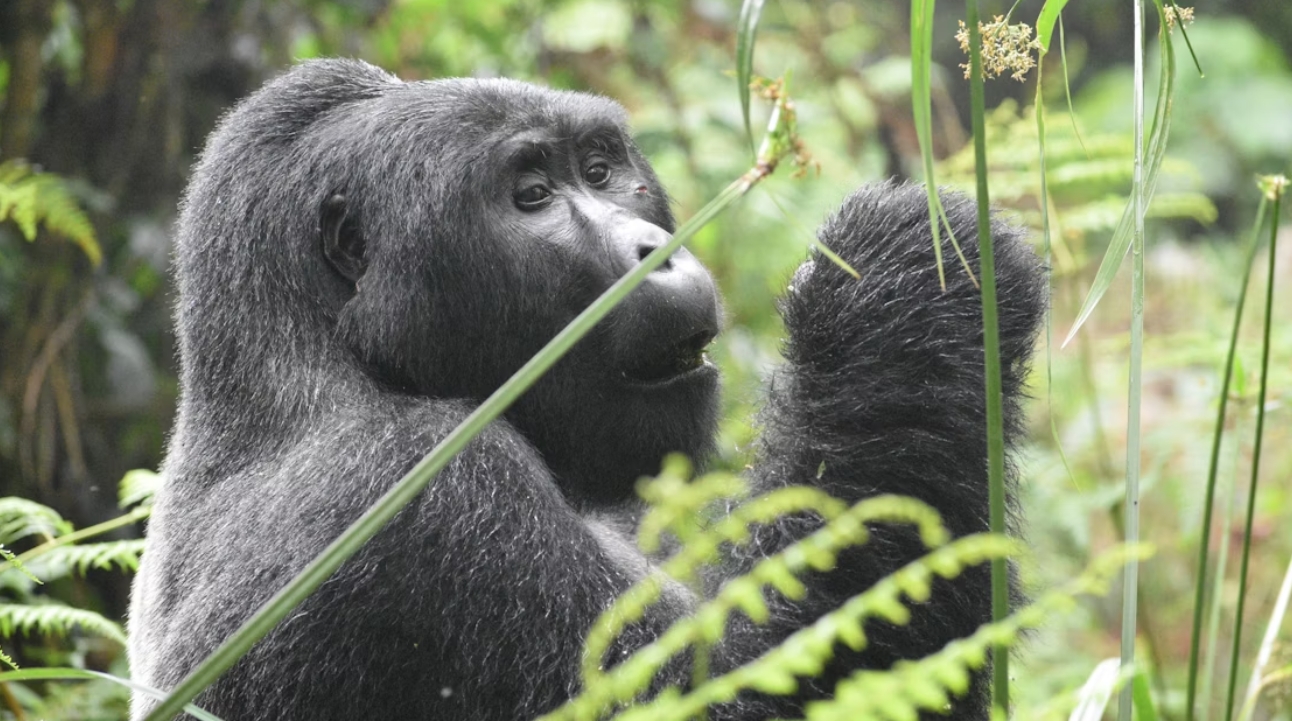
- Primarily, chimpanzees inhabit vast social groupings that often fragment into smaller groups in pursuit of limited food supplies before reassembling. In order to follow these breakaway groups, trackers frequently divide apart, which might confuse them if the chimps guide them back to the main group. In contrast, mountain gorillas have an abundance of food and live in a comparatively stable group.
- Mountain gorillas live in mountainous regions and on slopes, which can be stressful, whereas chimpanzees typically inhabit or live in relatively flat terrain. This is because mountain gorillas find it difficult to survive in traditional flat plains. After all, they usually inhabit high-altitude regions with montane forests.
- The age restrictions for these two experiences vary for tourists who intend to engage in both chimpanzee and gorilla trekking. Gorilla trekking requires participants to be at least 15 years old, and chimpanzee tracking requires participants to be at least 12 years old. Therefore, by the laws and regulations about these primate species, no one under that specific age must engage in these two activities.
- Given the difficult terrain of forests and steep slopes, gorilla trekking is typically more physically taxing than chimpanzee tracking.
- Mountain gorillas prefer to move and rest on the ground in a forest clearing, which is an exciting and daring experience for tourists and primate lovers. In contrast, chimpanzees are mobile and always roaming, so trackers must constantly and quickly follow them.
- Photographing chimpanzees is challenging because of their constant movements and habit of swinging from tree to tree as they climb up in the tree canopies, which is caused by their lighter bodies. Mountain gorillas, on the other hand, are heavier and seldom scale trees; as vegetarians, they spend most of their time on the ground.
- When tracking, chimpanzees are typically noisy makers and louder, whereas mountain gorillas typically play quietly while consuming leaves, shoots, twigs, and tree bark. Chimpanzees’ vocalisations become louder as they continue to grunt, but gorillas’ vocalisations are naturally gentle and low.
- Finding chimpanzee communities takes a lot less time than finding mountain gorillas, which can take several hours. In the forest, tracking chimpanzees can take two to three hours, whereas tracking gorillas can take two to seven hours. While tracking gorillas can be rewarding, it can also be exhausting.
- In order to control the number of visitors and give clients the opportunity to trek and track these intelligent chimps, the chimpanzee tracking experience is divided into two overlapping sessions: the morning session, which begins at 7:30 am, and the afternoon session, which begins at 2:00 pm. However, because gorilla trekking is so long, it is only scheduled for one morning session, unlike chimpanzee trekking, which is time-limited. This gives these gentle giants enough time to look for food sources.
- To limit the amount of time visitors can spend watching a mountain gorilla family, there is a one-hour limit. Nevertheless, depending on where they go tracking, tourists may be able to spend more time with a chimpanzee family in some nations and locations.
- There is a greater chance of seeing mountain gorillas in their natural habitat with gorilla trekking than with chimpanzee tracking, and the experience is typically more organised.
- In contrast to mountain gorillas, who spend most of their time on the ground playing, mating, feeding, and caring for their young, chimpanzees spend most of their time climbing trees in tree canopies, playing, grunting, and feeding, among other activities.
- Chimpanzee tracking only allows six people per chimpanzee family, whereas gorilla trekking only allows eight people per gorilla family once a day. Since these primates are susceptible to human illnesses, particularly the flu and the common cold, this is done to prevent overcrowding in their natural habitat and to regulate and control direct disease contact with them.
Conclusion
In order to gain access to these primates and engage in extensive trekking and habituation, gorilla trekking and chimpanzee tracking both require tracking permits or permission. But gorilla permits are more costly than chimpanzee trekking permits. Whereby a gorilla permit in Uganda costs three times as much as a gorilla permit in other countries. More still, If you intend to engage in these two activities, gorilla trekking and chimpanzee tracking, you should bring the following essentials: hiking shoes, long-sleeved shirts, pants, gaiters, extra batteries, a drinking water bottle, cotton socks, binoculars, a lightweight backpack, and water-resistant jackets, among other things.