The Hamerkop Master of Architecture
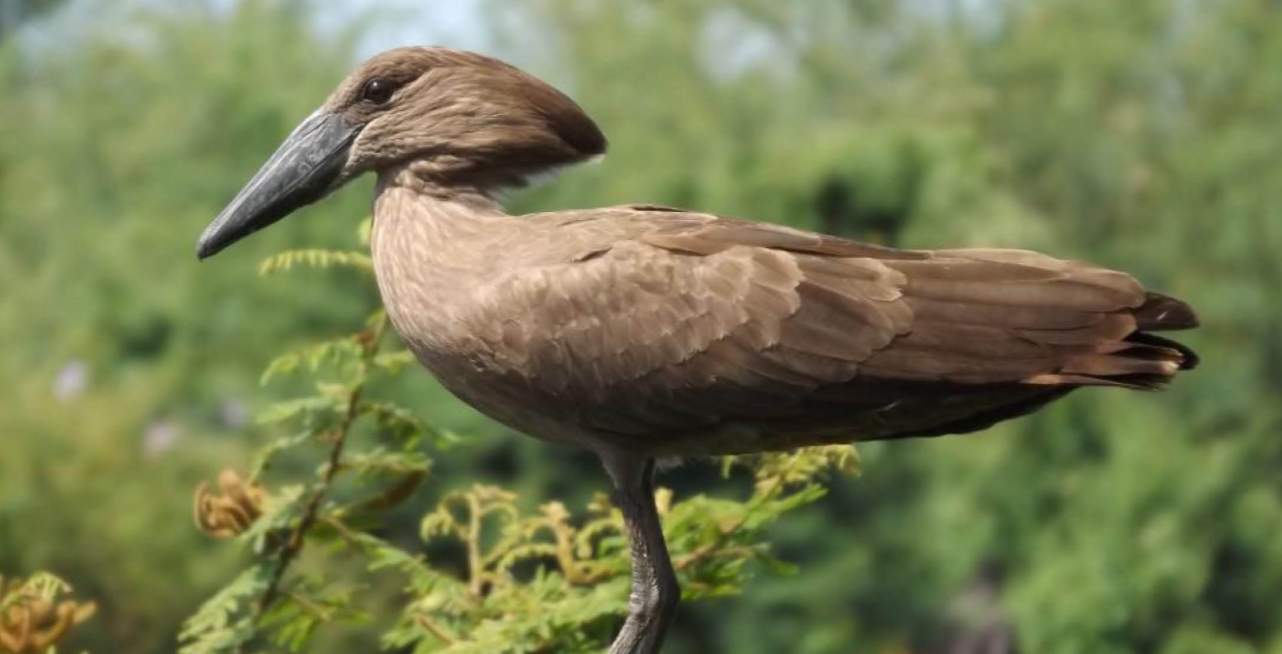
The Hamerkop Master of Architecture: This is a distinctive medium-sized bird species whose closest relatives are thought to be storks, herons, and pelicans. This bird species is the only surviving species in the genus Scopus and family Scopidae, getting its name from its hammer-like shaped head with a crest and a long, flattened bill. They always feed on a variety of including insects, amphibians, rodents, and other living organisms. In Uganda, this bird species can be seen in several protected areas such as Mabamba Wetland, Murchison Falls National Park, Lake Mburo National Park, Queen Elizabeth National Park, and Kibale Forest, among others.
It is a unique, non-migratory, brown, medium-sized bird that inhabits several parts of Africa, including marshes, lakes, riverbanks, ponds, and many other waterlogged areas. This bird species feeds on several types of prey, such as small aquatic living organisms, including insects, amphibians, and reptiles, such as fish, frogs, lizards, and others. However, this species can take on any prey that it can as part of its diet. It hunts its prey in shallow waters by sight through ambushing or by touch using its long, flat bill.
The species is praised for its huge nest, usually constructed during the active breeding season, which is a rare case with wading bird species; the nest comprises an internal nesting pouch or chamber where its eggs are laid for incubation.
Plumage-The Hamerkop Master of Architecture
This bird species stands at 56 cm high and weighs over 470 grams, and its plumage is brown with dazzling purple at the back. The tail has a faintly locked, darker brown color, and both males and females look similar; however, the male is slightly bigger than the female. The immature chicks always resemble the adult species. It has a long bill, which stretches about 85 mm and is slightly hooked at its end, similar to the majestic cormorant or the shoebill species.
Distribution
These bird species inhabit Africa, particularly in the south of the Sahara, coastal southwest Arabia, and Madagascar, mainly in shallow and running waters that are conducive for their prey, such as wetlands, rocky areas, lake shores, rivers, channel banks, irrigated farmland, and water channels, among others.
These birds are always active during the daytime, meaning they are diurnal, especially during morning and evening hours. This is because during noon time there is too much sunshine and temperatures are always high; therefore, you need to have a shade to keep away from the burning sun.
Vocalizations-The Hamerkop Master of Architecture
These birds are always silent, especially when alone, but can make loud calls when in groups or pairs. In groups, they make a wide range of calls, including nasal rattles and cackles, with a loud social call, “yip-purr,” and “yip” calls for bigger groups, giving way to purring notes.
Feeding
This bird species may at times feed alone or in pairs, but not in groups. It feeds on almost anything it can consume within its locality, despite small aquatic living organisms forming the larger part of its menu. They also feed on fish, lizards, and frogs, and always take small prey they can consume. They always hunt and stalk their prey through sight or by probing, especially within the shallow waters that may either be clear or muddy. However, these bird species can also feed while in flight, especially after snatching their prey with their bills and swallowing while soaring.
Nesting-The Hamerkop Master of Architecture
This bird species constructs a huge nest that is over 1.5 m, mainly built in between branches of a given tree, especially near water sources. This enormous nest is constructed from materials such as mud, sticks, and grass, among others, collected from the nearby surroundings. As they collect mud for construction, they always search for insects, especially near ant hills for termites and others.