Secrets of Mountain Gorillas
Secrets of Mountain Gorillas: These magnificent apes are a type of eastern gorilla that has been classified as endangered since 2018 by the IUCN. They are very strong and large primates, known for their broad chests and raised shoulders. These unique animals attract many tourists. Scientists believe they evolved from monkeys and apes around 9 million years ago in Africa and Arabia. About 2 million years ago, eastern gorillas separated from western gorillas, and 400,000 years ago, mountain gorillas split from eastern lowland gorillas. The name “gorilla” was used starting in 1852, and in 1967, Colin Groves named the different gorilla species. Further details on their origins will be discussed in the post.
Why are they called gorillas?
The word “gorilla” comes from the ancient Greek term “gorillai,” which means a tribe of hairy women, as mentioned by Hanno the Navigator, a Carthaginian explorer. This term is believed to have roots in Punic and an African language. A U.S. missionary coined it in the 19th century from the Greek word. Originally, Hanno referred to “wild, hairy people” around 500 B.C.E. The name stems from local communities on Africa’s west coast describing the great ape, which is known for its strength, muscular body, and intelligence.
Habitats of Mountain Gorillas
Following the Secrets of Mountain gorillas, they live only in Uganda, Rwanda, and the Democratic Republic of the Congo, mostly in specific national parks. They live at high elevations, making nests from leaves and twigs for sleeping. Their lifespan is about 50-60 years, and they breed slowly, with females giving birth every four years. In contrast, lowland gorillas have a larger population. Mountain gorillas are critically endangered and cannot thrive in captivity, with only 14 individuals recorded in a 2018 census, leading to their classification as endangered by the IUCN.
Physical Characteristics of Mountain gorillas
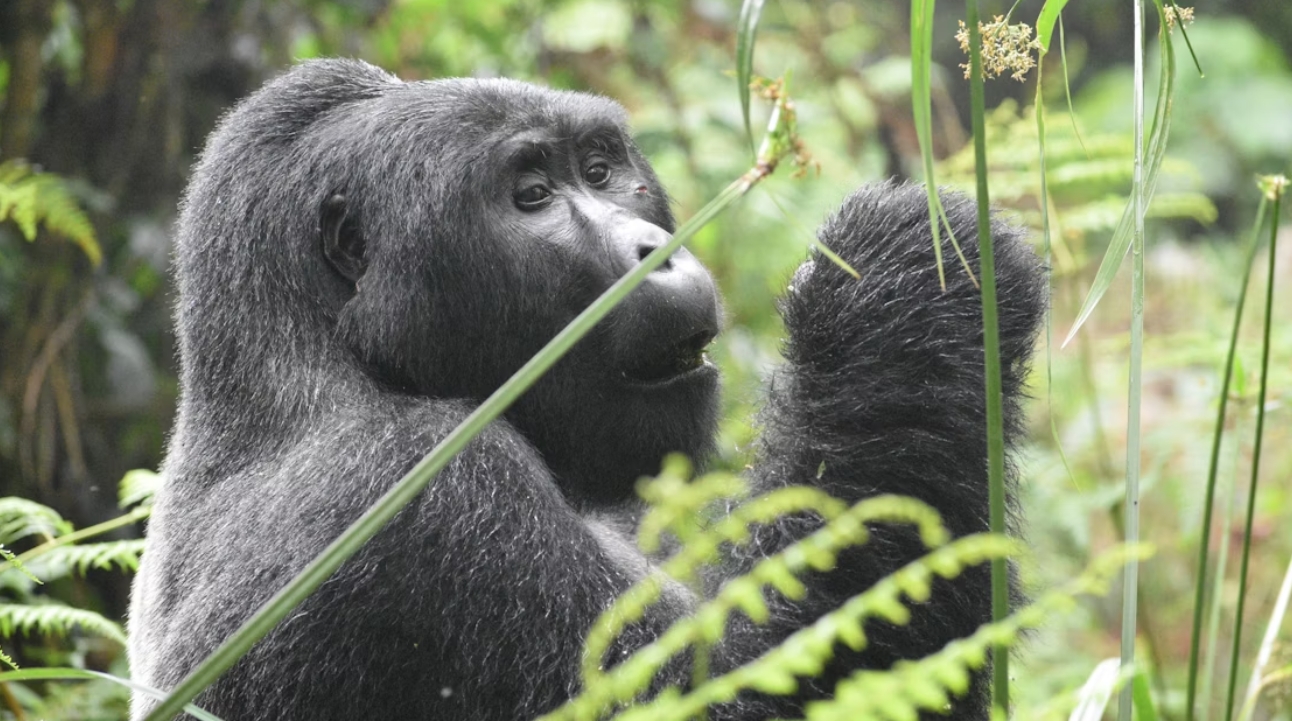
The endangered mountain gorillas have thicker fur than other gorilla species, helping them live in cold, high places. Adult male silverbacks can weigh up to 195 kg and are much stronger than humans, while females weigh about 100 kg. Each gorilla has a unique nose print, dark brown eyes, and longer hands. They move by knuckle-walking and are active during the day, searching for food like insects, leaves, roots, and fruits.
According to the information provided, mountain gorillas can adapt to colder, higher-altitude conditions because their fur is thicker than that of other gorilla species. Adult males, also known as silverbacks, are dominant males who are family-oriented, intellectual, quiet, and reserved but who also tend to be protective of their family. They are significantly stronger than humans and can weigh up to 195 kg; females weigh about 100 kg. In addition to characteristics like dark brown eyes and longer hands, each gorilla may be identified by its nose print. They are diurnal, moving mostly by knuckle-walking, and forage for insects, leaves, roots, and fruits every day from 6:00 am to 6:00 pm.
Mountain gorillas have clear daily patterns that include vigorous feeding in the morning and rest intervals that encourage play and grooming, which foster social bonding. Vocalisations are used for communication, and as night falls, adults construct ground nests out of leaves for both themselves and their young. Although they mostly live on the ground, they can occasionally scale trees in search of fruit, albeit doing so puts them at risk of falling. They prefer using logs to traverse water and stay away from some insects and reptiles. When they reach adulthood, female silverbacks frequently depart to join other groups, but socially, they form coherent groups under the leadership of a dominant silverback. While the loss of a leader can jeopardise a group’s stability, the silverback guards the group and settles disputes. Even though they are powerful, mountain gorillas are generally kind and only use violence when required.
Dian Fossey and her research on mountain gorillas
After learning about mountain gorillas, Gorilla beringei was named after Captain Robert von Beringe, who discovered the species on an expedition in East Africa. George Schaller and Dian Fossey are important gorilla researchers who made major strides in conservation efforts starting in 1967. With a focus on community engagement and law enforcement against poaching, Fossey carried out the first gorilla census and invented habituation procedures. Her legacy lives on through the Dian Fossey Gorilla Fund International, even though her murder was ultimately caused by her commitment to conservation.
Gorilla Trekking
Even though they are more costly, gorilla trekking safaris offer a more adventurous and unique wildlife encounter than regular safaris. They are classified as endangered because only about 1,063 mountain gorillas remain, mostly in Rwanda, Uganda, and the Democratic Republic of the Congo. Though many tourists visit both Rwanda and Uganda for a variety of tracking situations, opinions on which country is ideal for gorilla safaris are divided. Gorillas must undergo a protracted acclimatisation procedure because only 20% of them are habituated. Tracking can take anything from 30 minutes to 8 hours, and tours are most enjoyable after the wet season. Success rates are more than 90%; however, there is no assurance that you will encounter gorillas. Visitors can engage in other activities after tracking, and Nakra Safaris provides packages specifically designed for these excursions.
Threats and Conservation
Following the secrets of mountain gorillas, over 1,063 individuals face endangerment mainly due to human activities like poaching, particularly in the Democratic Republic of Congo (DRC). Despite challenges, their numbers are gradually increasing thanks to gorilla tourism and protective initiatives. Key conservation efforts include the Senkwekwe gorilla orphanage and increased armed patrols in Virunga National Park. The International Gorilla Conservation Programme, active since 1991, supports these initiatives. Controversial evictions of local communities have helped stabilise populations, but greater community involvement in tourism is essential for lasting success.